How to self-host your Base44 app (without it still running on Base44)

Daniel Frishtik
Founder of EscapeBase44 ·
You can't self-host Base44, and copying your app's files onto your own hosting doesn't do it either: the app would still secretly run on Base44, and still need the subscription. What you can do is move the whole app, with a backend of its own, onto hosting you actually own. After that it's a normal app on normal infrastructure: Vercel, AWS, Hetzner, even a server in your office. Usually for $0 a month.
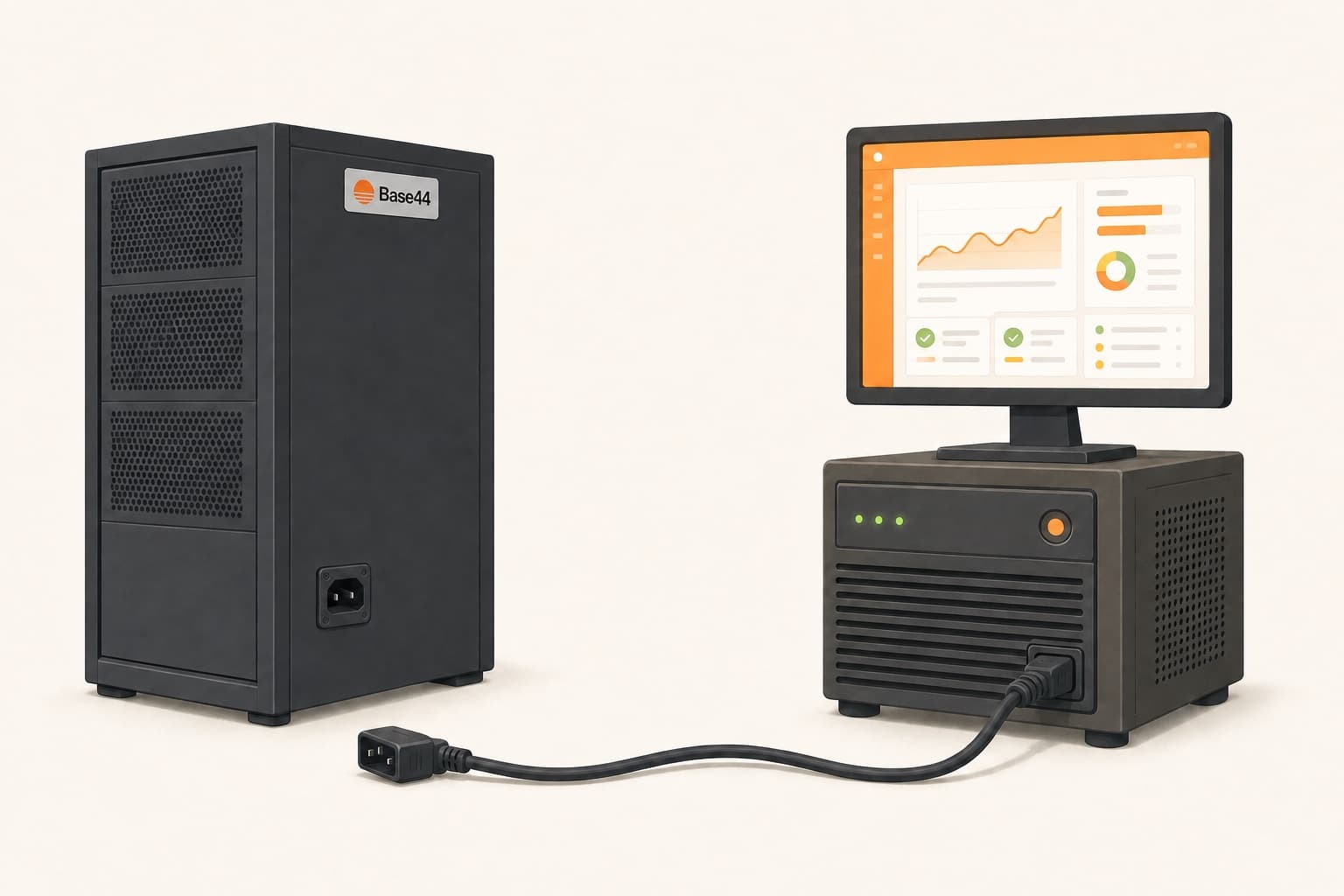
Base44 hosts your app. That's the deal, and that's the catch
When you build on Base44, hosting is included. Your app is live the moment it's created. There's no deploy step and no server to set up. This is a real part of why building there feels so easy.
The catch is that this hosting isn't a service you can take somewhere else. There is no server behind your app that's yours. Your app lives inside Base44's own infrastructure, on the same servers that run everyone else's apps, together with your login system, your database, your uploaded files and your backend functions. Hosting isn't a piece of your app that you could move. It's one of the jobs Base44's platform does for it.
With a WordPress site you can copy everything to a new host, point your domain at it, and cancel the old host. There is nothing like that here. There's also no hosting-only plan: once you're done building, the cheapest way to keep a real app fully working on your own domain is the Builder plan, $50 a month, forever. People keep asking Base44 for a cheap keep-it-alive plan. It doesn't exist.
$50 a month while you're building is fair. $50 a month so a finished app doesn't break is what sends people to this question: can't I just host it myself? So the next idea is obvious, and everyone has it. Download the code, upload it to your own hosting, done.
Moving the files to your own hosting moves the screen, not the app
Here's what happens when you try. You export the code (ZIP or GitHub, on Builder and up), put it on your own hosting, open the URL, and it works. The site loads from your server. Users can log in. Data shows up. It really does look like you just self-hosted your app.
It works because nothing actually moved. Every time the app logs someone in, reads a record, saves a form, uploads a file or runs a backend function, it calls Base44's servers, exactly like before. Your hosting serves the screen. Base44 still runs the app behind it. You now have two bills: your hosting, and the Base44 subscription your app still can't live without. Cancel Base44, and the app on your beautiful new server breaks.
And you won't hear this from the people selling the move. There are step-by-step videos for deploying your Base44 app to this host or that one, and hosting companies that literally sell "Base44 hosting" plans. They all move the files. None of them mention the part that stays behind.
And if your hosting is the classic kind, cPanel, Plesk, an FTP folder, it can't even hold the part that's missing. What's missing isn't files. It's a running server program: the thing that logs your users in, decides who can see what, and runs your backend logic. Shared file hosting has nowhere to run a program like that.
See exactly what Base44 export includes (and what it doesn't)Can you self-host Base44 itself? No.
If Base44's backend were something you could download and run, this article would be one paragraph. It isn't. Base44 is not open source, there's no server download, no Docker image, no on-premise version. Even their own developer platform, which lets you host the frontend wherever you want, keeps the backend services on Base44 in every setup it supports.
Base44 did recently ship a local development server, and it's a genuinely nice tool: it runs your backend functions on your machine against throwaway test data, so you can try changes before deploying. But login, AI and email still go through Base44, the data is a temporary sandbox, and your live app keeps running where it always did. It's for developing, not for hosting.
People have asked Base44 directly for self-hosting, for on-premise deployment, for a Docker export of their app. Those requests sit open. I don't expect that to change, honestly. Hosting your app is the product. If the app could leave, the subscription could too.
So the real question was never "how do I self-host Base44." It's: what would my app need, to run without Base44?
What your app actually needs to run on your own hosting
Three things, and they're the same three whether you do this yourself or someone does it for you.
A backend of its own. Something on your side has to do everything Base44's servers were doing: log users in, enforce who's allowed to see which record, read and write the data, store files, run your backend functions and automations. This is the part Base44 never gives you, and it's most of the work.
Your app's live contents, out in usable shape. The records with their relationships intact, your users in a form that still lets them log in, the files people uploaded, the settings and permission rules. Not as spreadsheet copies, but in a form the new backend can actually run on.
Everything wired back together. The app pointed at the new backend instead of Base44's, functions connected to their triggers, file links rewritten, secrets in place, and every flow tested with real accounts.
Now, honestly: if your app is basically a brochure, pages and images with no login and no data, you don't need most of this. Export the code, host it anywhere, and you're done. You can do that yourself this afternoon, for free.
A real app is a different story. If you're technical and the app is simple enough, you can rebuild the missing backend on your own stack, and some people pull it off. The ones who write about it describe all-nighters, logins that break, and weeks of being "95% done." If you're not technical, this is the project agencies quote in the thousands of dollars.
So no, it's not a hosting problem. Your app doesn't need a better server. It needs a backend that can leave with it.
This is why I built EscapeBase44
I got stuck in exactly this spot with my own app. I had a server ready and nothing I could put on it. So I ended up reverse-engineering Base44's entire backend, every endpoint, until apps couldn't tell the difference between it and the real thing, and then I automated the whole move. That became EscapeBase44.
It migrates the app you already built, as is: the frontend, the backend behavior, the database with every record, your users and their logins, backend functions, automations, integrations, files, secrets and the configuration tying it all together. Everything gets deployed onto accounts you own, and the complete code, your own backend included, lands in a private GitHub repo of yours. Your Base44 app stays untouched the whole time. Afterwards you can keep changing the app through an AI chat, just like you did in Base44, or hand the repo to Claude Code, Cursor or any developer.
Pick where your app lives: Vercel, AWS, Hetzner or your own server
Once your app has its own backend, it stops caring who hosts it. Hosting becomes a choice again, and every option here is an account under your name.
Vercel. Free until you have real traffic, and right for most apps. The one exception: if your app uses realtime features or agents, it needs a real server instead, because Vercel can't hold a live connection open.
Hetzner. A solid European server for about $10 a month. This is what I'd pick for a realtime app if you don't already have a cloud account somewhere.
AWS. A Lightsail server from about $12 a month, under your own AWS account. If your domain already lives at AWS, this puts everything in one place.
Your own server. Any machine you can SSH into as root: a VPS at any provider, the box in your office, even the mini PC already running your media server. The app runs on your machine in Docker. The database runs in your own MongoDB Atlas account rather than on the box itself, free until heavy traffic.
Azure or Google Cloud. The migration doesn't deploy to their managed app platforms. But a plain virtual machine at either one is just a server, which the "your own server" option covers fine.
A few things people always ask about: server deployments ship with their own Dockerfile and compose file, committed in your repo, so the Docker setup is yours to read and change. The repo also comes with instructions for running the whole app locally on your laptop, backend included, which is the real version of what "run it locally" was supposed to mean. And your domain stays wherever it's registered. It just gets pointed at the new home, the same way you'd point it at any host.
When you push a change to your repo, the app redeploys automatically. That's it. You're as free as any regular developer, because that's what you are now: someone with a normal app on normal infrastructure.
What hosting costs after the move
On Base44, the subscription is the hosting bill: $50 a month to keep a finished, real app fully alive on your own domain.
After the move, a typical single app costs $0 a month to host. Vercel is free until real traffic. MongoDB Atlas is free until heavy traffic. That's not a trick, it's their business model: hosting normal apps is cheap, and providers give it away to win you early. Not every app stays free, to be clear. Heavy features and real traffic cost real money. But at that point you're paying for servers, directly, at provider prices.
Base44 rents this same class of infrastructure and meters it back to you through a subscription. While you're building, that bundle genuinely earns its money. Once you're done building, why keep a middleman? The migration is one payment, there is no EscapeBase44 subscription, and nothing about your app is rented anymore.
Move your app once, and hosting is just hosting again, on accounts you own.
Base44 self-hosting FAQ
Can I self-host a Base44 app?
Not by exporting it. The platform itself can't be self-hosted, and the exported code still runs on Base44's servers. What works is migrating the app with a replacement backend. After that it runs fully on hosting you own.
Does Base44 host websites?
Yes. Hosting is built in: your app is live the moment it's created, with no deploy step. The catch is that the hosting can't be separated from the platform, so your app can only be hosted by Base44 while it's a Base44 app.
Is Base44 open source?
No. Base44's public GitHub holds developer tools and examples, but the platform and its backend are closed. There is no version of Base44 you can download and run yourself.
Can I run my Base44 app locally?
The exported frontend runs on your machine, but it still calls Base44's servers for login and data. Base44's local dev server is a testing tool with throwaway data, not a way to run your live app. After a migration, your repo comes with instructions for running the entire app locally, backend included.
Can I move my Base44 app to AWS?
Yes. EscapeBase44 can deploy it to a Lightsail server under your own AWS account. Copying the exported files into S3 alone doesn't do it: the app still runs on Base44 until its backend is replaced.
Can I move it to Azure or Google Cloud?
Not to their managed app platforms today. But a plain virtual machine at either one is just a server, and the migration can deploy to any server you can SSH into.
Can I host a Base44 app on shared hosting like cPanel or Plesk?
No. The part your app is missing is a running server program, and file-based shared hosting can't run one. You need Vercel-style hosting or a real server (a VPS). Your domain and email can stay right where they are and just get pointed at the new home.
Does Base44 have a hosting-only plan?
No. Keeping a real app fully working on a custom domain takes the $50/month Builder plan, even when you're done building. People have been asking Base44 for a cheap keep-it-alive plan for months. It doesn't exist.
What does hosting cost after leaving Base44?
Usually nothing at first. Vercel's and MongoDB Atlas's free tiers cover a typical single app until it has real traffic. A heavy app pays normal provider prices, directly, with no markup and no middleman.