Base44 down again? Save your app from its reliability issues

Daniel Frishtik
Founder of EscapeBase44 ·
Base44 has had 44 outages in 14 months, and every time it goes down, your app goes down with it. The only way out is to move your app onto hosting you own.
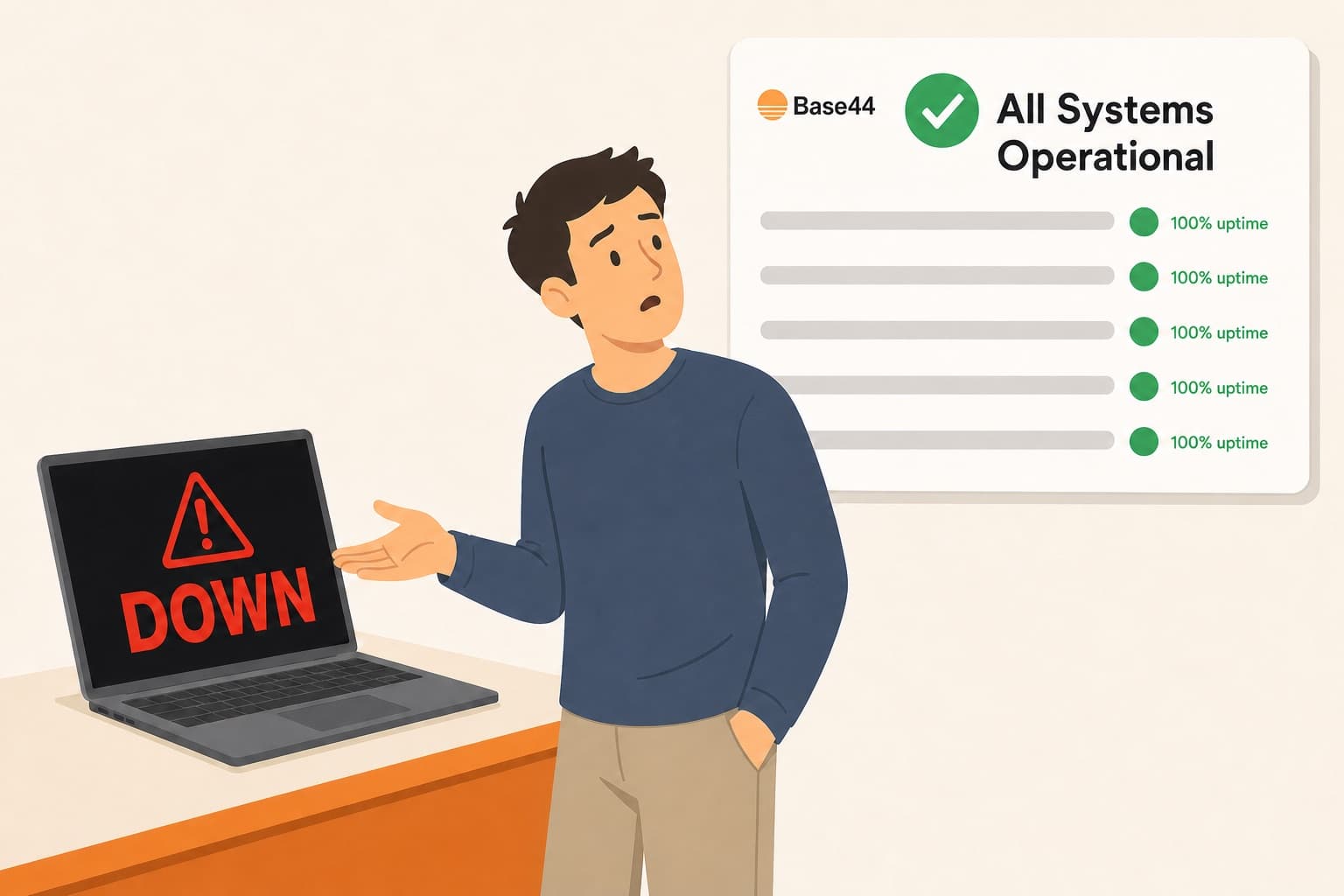
Your app worked last night. This morning it's a 502 Bad Gateway, or a white screen, or the “Loading your app” spinner that never ends, and the people who use it are already writing to you. You refreshed, cleared the cache and tried another browser. You opened Base44's status page, and it says “All Systems Operational”. The AI chat still answers, and it's still charging you credits to “fix” a problem that isn't in your app.
This keeps happening. I get emails like this one: “4 times in the last 2 months Base44 has been down so it's not reliable enough really.” Base44 goes down about every ten days, and every app on it goes down at the same moment. That's what relying on a vibecoding platform means, and nothing you do inside your app changes it.
Is Base44 down right now? How to actually tell
You won't find out from Base44's status page. It says “All Systems Operational” through most outages, because Base44 logs an outage after it's over, if it logs it at all. So while one is happening the page is green, and you're left guessing whether it's them or you.
It's them if your app worked, you changed nothing, and now you're seeing one of these:
- a 502 Bad Gateway or a 503, which means your users' browsers asked Base44's servers for your app and got no answer
- a 500 internal server error
- a white screen, or a spinner stuck on “Loading your app”
- a login that sends you straight back to the login page
- your custom domain saying “Domain Not Recognized”
- the preview saying the server's IP address can't be found
- the builder not loading either
The fastest way to be sure is other people. Open r/Base44 and sort by new: when Base44 is down, there's a “Base44 down?” thread from the last few minutes with everyone else in it. StatusGator, a site that watches status pages and collects users' reports, lists outages Base44's own page never shows. Downdetector collects reports the same way.
Sometimes the app loads fine for you while your users say it's dead. In March and again in May 2026, some internet providers blocked Base44's domain (Comcast's Xfinity in May), so every Base44 app was down for their customers and up for everyone else. People found that a VPN fixed it, but only on their own computer. It did nothing for their users.
While it's down, nothing you change in your app will bring it back, because the problem isn't in your app. So don't ask the AI to fix it. It keeps answering during an outage and charging you for every attempt, and you don't get those credits back: Base44's terms say credits spent while the platform is failing aren't refunded. Tell your users it's a platform outage. Then wait. On Base44, that's all you can do.
Base44 goes down about every ten days
Base44 has had 44 outages in the 14 months since August 2025. That counts every day the live apps, the builder or the login were down for enough people to fill a thread on r/Base44 or Base44's feedback board, or to show up on StatusGator. The only month without one was September 2025. Some lasted twenty minutes, some lasted days. These are the ones people remember:
- August 19, 2025: every app down, and app data gone. The whole platform went down overnight, and when it came back, data was missing. “All the user data on my site just got completely deleted in one fell swoop.” One owner with 20 apps on Base44 went to bed not knowing whether any of his data was coming back. The next morning Base44 called it a technical issue that had temporarily affected access to some app data. By the time the data came back, some owners had already lost clients.
- February 3, 2026: the demo-day outage. Every app returned 502 for half an hour and ran slow for hours after, and Base44's support site was down with it. One owner had a demo scheduled a month in advance: “App dead. No fallback. No local run. Nothing. A full month of preparation just to sit there explaining ‘yeah, the platform I depend on is offline’. It makes me look amateur, even though the failure wasn't mine.” Another was about to send a client's office manager the link that morning, with the client already prepared to pay.
- March 17 to 22, 2026: days down for some users, with the status page green the whole time. “Day 2 of Base44 being down. And still no word from anyone at the company.” Two days in, Base44 said some internet providers were blocking its domain. One owner was about to move 12 companies and almost a thousand people onto his app, and after this he wasn't sure he could. Base44's incident history lists nothing between March 3 and April 9.
- June 2, 2026: an owner's records vanished during the outage. They disappeared from his app's data section in the middle of it, and support told him to export the data, the data that wasn't there. He rebuilt it himself, and now he copies everything to Google Sheets every night. On the status page the incident is called “Mongo heavy load” (Mongo is the database behind Base44 apps), and it's logged as zero minutes. The next day two owners on the Elite plan were still stuck. One sends customers live data every morning and hadn't for two days. The other was supposed to present data that day.
- October 13, 2026: a change to Base44's database. Apps ran slow and threw “too many requests” errors for most of a day. StatusGator saw Base44's own status page show a warning for almost 22 hours. Base44's history logs the incident as zero minutes.
And on October 20, 2025, when AWS went down, Base44 went with it: custom domains answered “Domain Not Recognized” and everything else answered 502, as one owner was about to meet a client and show them the app he'd built for their business. Base44's status page shows nothing for that day.
The rest were shorter: 503 errors that come and go for an hour, mornings when every published app sits on “Loading your app”. “Down again? Cannot load app preview nor my app itself on my custom domain,” one owner wrote in January. “Of course can still chat with the AI and burn credits though.” “It's so frustrating that it is so unreliable,” another wrote in August.
Why Base44's status page says everything is fine while your app is down
Open status.base44.com and it shows 100.00% uptime on every component for the last 60 days. In those same 60 days Base44 logged three incidents itself, and during one of them the status page showed a warning for almost a day. The uptime still says 100.00%.
Since May 2026, 16 of the 18 incidents on the page have exactly one update, posted after the outage was over, and it reads “Resolved after 0m”. So on the page, the outage lasted zero minutes. Nothing is posted while it's happening, and once it's over the record says it took no time at all, so the uptime number never moves.
On July 27, I watched Base44's servers answer ten to eighty times slower than normal, or not at all, for about half an hour. Base44 posted that incident seven minutes after it ended, as zero minutes. Earlier that same day there had been another outage (“Site is down cant login cant submit tickets,” someone wrote on reddit), and that one isn't on the page at all.
Go further back and the page shows even less. Its history starts in December 2025, and every month before that, back to February 2025, says “No incidents reported”. That includes August, the night the data disappeared, and October, the day AWS took every app down.
StatusGator gives Base44's status page a D for accuracy. On average the page is two to four hours late, and StatusGator lists nine outages since late May that Base44's page never acknowledged at all.
And because the status page is what Google reads, Google repeats it. Ask Google whether Base44 is down, and its AI answer reads the page back to you: operational, 100% uptime across all components, zero-minute impact.
The status page only exists because users begged for one after that night in August 2025. The request got 119 votes on Base44's feedback board. What they got is a page that says everything is fine.
Why your app goes down every time Base44 does
A Base44 app has no server of its own. Every time someone signs into your app, opens a record, taps a button, uploads a file or uses its AI, the work is done on Base44's servers. The page in your users' browser is only the front, and everything behind it is Base44's. So when anything under Base44 fails, your app fails, at the same moment as every other app on the platform.
What your Base44 app actually runs on, and why you can't reach any of itAnd a lot under Base44 can fail. Base44's own servers and database fail, like on June 2 (“Mongo heavy load”) and October 13 (“a change to our database”). So do the companies Base44 runs on. When AWS went down on October 20, 2025, every Base44 app went down with it, and Cloudflare's outage on December 5 did the same. When Modal, the company that runs Base44's builder and previews, went down on December 28, the builder went with it. And when Base44's AI provider had trouble on June 16, 2026, the AI features inside live apps failed for two hours.
Outages aren't the only way the platform takes your app down, either. The code your live app runs on is Base44's, and Base44 changes it whenever it wants. In May 2026, every AI call one owner's app made started failing after one of those changes, and he hadn't touched his code. And Base44 can switch your account off. On October 18, 2026, one owner's websites all went down with “User is disabled”: Base44 had switched off his account and cancelled his paid plan without a word to him.
What Base44 promises you about uptime: nothing
Base44 doesn't promise any uptime on any plan, Enterprise included. What Enterprise gets you is a dedicated support queue. One Elite subscriber complained on Base44's feedback board that on Elite, a critical issue can wait 48 hours for a response.
Base44's terms put it in writing. You get the platform, and every app on it, as it is, faults included. Base44 doesn't promise the service won't be interrupted or won't have errors, takes no responsibility for downtime or lost data, and makes backing up your data your job. It can change or shut down any part of the platform at any time, with or without telling you, and it can suspend your account without owing you anything. So when a client asks what uptime you can promise them, you can't promise any, because nobody promised you any.
What people try, and what each one actually gets you
After the second or third outage, people stop waiting on Base44 and try to protect the app themselves:
- Monitoring, and an outage page. An uptime checker that tests your app every minute, or StatusGator's alerts, tells you a few minutes before your users do. A “we're having issues” banner inside the app never shows up, because it's part of the app that's down. You find out sooner. Your app is down just as long.
- Upgrading the plan. Every plan runs on the same servers and the same database, so when Base44 goes down, Elite and Enterprise apps go down with everyone else's. In February an Elite subscriber wrote that he'd been down for two days.
Hosting the screens yourself. People take Base44's export, which is the code of their screens, and put it on their own hosting, so the page loads while Base44 is down. It loads, and nothing on it works: signing in, every record and every button still go to Base44's servers, because that's where your app actually runs. A page that opens and can't do anything is still down for your users.
Why an exported Base44 app still can't run without Base44- Exporting the data every night. Some owners copy their records to Google Sheets every night, so the next time records vanish they have a copy. On Base44 that's worth doing. It does nothing for uptime: when Base44 goes down, your app is still down, and a spreadsheet of your records isn't your app.
Rebuilding on another builder. That gets the app off Base44, but only by writing it again from scratch. It takes months, your data and your users have to be brought over by hand, and when it's done you have a new app on another platform, which goes down when that platform does.
Why every other builder means rebuilding your app, and what to do instead
Everything here except the rebuild leaves your app on Base44, so it still goes down whenever Base44 does. The rebuild gets you off Base44 by throwing your app away. What you actually need is the app you already have, as it is, running somewhere Base44 can't take it down.
How to get your app off Base44 as it is
Most apps on the internet don't live inside anyone's platform. Their owner has accounts with a hosting provider and a database service, and the code sits in the owner's own GitHub. The app depends on those providers and nothing else: no other company changes the code under it, and no other company can switch it off.
Almost nobody runs a Base44 app like that, because Base44 doesn't let you. The export gives you the screens. Everything that makes them work is Base44's backend: the server code that signs people in, reads and writes every record, runs your functions, serves your files and sends your emails. That code runs every app on the platform, and Base44 keeps it to itself. So moving an app off Base44 as it is means building Base44's whole backend again, from scratch.
I did that to get my own app off Base44. It took months to write Base44's entire backend again, from the sign-in to the files, until my app ran without Base44 at all. Then I made the whole move automatic, for any Base44 app, and called it EscapeBase44.
Your part is short: sign in with Base44, pick your app and choose where it should run. The migration does the rest. Every screen, record, file and backend function comes across, and so do your users, with the passwords they already have. Base44's backend comes too, rebuilt as code in a GitHub repository of your own, so the server code your app runs on is yours now. Nothing about the app changes for the people who use it. Your Base44 app stays exactly as it is during the move, so it keeps working until you've checked the new one. Then you cancel Base44.
The next time Base44 goes down, nothing happens to your app
From then on your app runs on the providers you picked. When Base44 goes down, your app stays up. Base44's changes don't reach it either, because the only person who changes your app's code is you. No platform account holds your app, so nobody can switch it off, and the database is yours, with backups you control.
Whether a business can run on Base44 at all, and how to make your app production readyHosting providers go down too. AWS and Cloudflare each took Base44 down in 2025, and the hosting you pick can go down the same way. But most of Base44's outages weren't a provider's. Base44's own servers and database went down, one of Base44's changes broke an app its owner hadn't touched, and Base44 switched another owner's account off. Relying on a vibecoding platform means your app depends on all of that: on the hosting Base44 rents, on the AI vendors Base44 picked, and on Base44 itself, a company that goes down about every ten days and promises you nothing about it. On your own hosting, it's a completely different situation. Pick AWS and your app runs on the company that hosts Netflix, McDonald's and the CIA. When AWS goes down, it's world news, because it's rare, and a good part of the internet is down with you. Nobody writes a headline when Base44 goes down. There'd be one every ten days.
You keep building it the way you like. The code is yours, backend included: you can work on it with AI the way you did on Base44, or give it to Claude Code, Cursor or a developer of your own. It's a normal app now, and Base44's outages are Base44's problem.
Your app doesn't have to go down every time Base44 does.
One-time, priced to your app.
See how the migration worksBase44 downtime FAQ
Is Base44 down right now?
Its status page won't tell you. It logs most outages after they're over, as zero minutes, and shows 100% uptime in the meantime. The fastest way to know is r/Base44 sorted by new, or StatusGator, an outside monitor that lists outages Base44's own page never mentions.
Why isn't my Base44 app loading?
If it worked yesterday and you changed nothing, it's Base44. A 502 Bad Gateway, a 500 error, a white screen or a spinner stuck on "Loading your app" all come from Base44's servers, and nothing you change in your app fixes them. If it loads for you but not for some of your users, their internet provider may be blocking Base44, which happened in March and in May 2026.
How often does Base44 go down?
About every ten days: 44 outages in the 14 months to October 2026, counting the days the live apps, the builder or the login were down for enough people to report it. Most last from twenty minutes to a few hours, and the worst went on for days.
Does Base44 have an SLA or an uptime guarantee?
No. Base44 has no uptime commitment on any plan, Enterprise included. Its terms say the platform and every app on it come as they are, with no promise the service won't be interrupted and no responsibility for downtime or lost data.
Do I lose my data when Base44 goes down?
Sometimes, yes. In August 2025 app data disappeared across the platform overnight, and in June 2026 an owner's records vanished from his app in the middle of an outage. Base44's terms make backing up your data your job.
Does Base44 refund credits used during an outage?
No. The AI chat keeps answering and keeps charging while the platform is down, and Base44's terms say credits spent during errors or interruptions are not restored or refunded.
Where are Base44's servers?
Your app has no server of its own: it runs on Base44's shared servers, together with every other Base44 app. Those depend on AWS and Cloudflare, which is why the AWS outage in October 2025 and the Cloudflare outage that December took every Base44 app down.
Why is Base44 so slow?
Every request your app makes goes through Base44's shared servers and database, so when they're under load, every app on the platform slows down at once. That happened on June 2, 2026 ("Mongo heavy load") and again on October 13, after a change to Base44's database. Nothing you do inside your app speeds that up.
Is Base44 reliable?
No, not for an app other people depend on. It has gone down about every ten days for over a year, there's no uptime commitment on any plan, the status page logs outages after they're over, and support takes a day or two to answer. If your app has users who need it, it has to run somewhere else.
Will my app go down if Base44 goes down after I move it?
No, because after the move your app runs on your own hosting, not on Base44. The only time it checks with Base44 is the first sign-in of each existing password user, when their password is confirmed once against your old Base44 app, so if Base44 is down at that moment, that one sign-in fails until it's back. Every sign-in after that, and every Google sign-in, happens without Base44.
Do I keep my app live on Base44 after the move?
Only until you've seen the new one working. Then cancel your Base44 subscription, but leave the Base44 app in place until every existing password user has signed in once on the new one.